

Pittsburgh Housing Market Trends and Forecast

If you are looking for a sea change in the housing market, either locally or nationally, it is unlikely that 2026 will be the year for such change. The major factors that influence housing – mortgage rates, inventory of homes for sale, new construction, employment, and the economy – show little or no signs of moving far from the trends of the past few years. For homeowners and sellers (and homebuilders, to a degree), that is not bad news. For those wanting to purchase a home, such a forecast means that the challenges
of the post-pandemic housing market
will mostly remain.

After a bump in inventory and sales through April 2025, the pace of home sales in Pittsburgh retrenched in 2025 to a slower pace of transactions than for the full year 2024. During 2024, 1.85 percent of the existing homes sold in the 10-county metro Pittsburgh market. Last year that rate fell to 1.81 percent, or 18 homes in 1,000. It has been since 2021 that more than two percent of the existing and new homes changed hands in Pittsburgh, a pace that was much lower than the U.S. average of 35 homes per 1,000.
Unfortunately, new home construction did not shake free of the challenges facing residential development in 2025, although activity was higher. Construction of single-family homes rose by 7.7 percent, or 226 homes, compared to 2024. Builders pulled permits for 3,156 new homes in 2025, more than one-third of which were townhouses or other attached homes. Even at the higher volume of construction, the additional new homes added less than one-half percent to the average of roughly 5,000 homes for sale in Pittsburgh at any point during 2025.
Demand for homes did not slip in 2025 and should not cool in 2026. By the same token, the supply of homes for sale is unlikely to increase in a meaningful way, despite modest improvements in the conditions holding the housing market in check. Those conditions – higher mortgage rates, Baby Boomers’ reluctance to move, higher home prices, and a shortage of buildable lots – will keep the Pittsburgh market from seeing a breakout in sales or new construction in 2026.
The Outlook for Rates
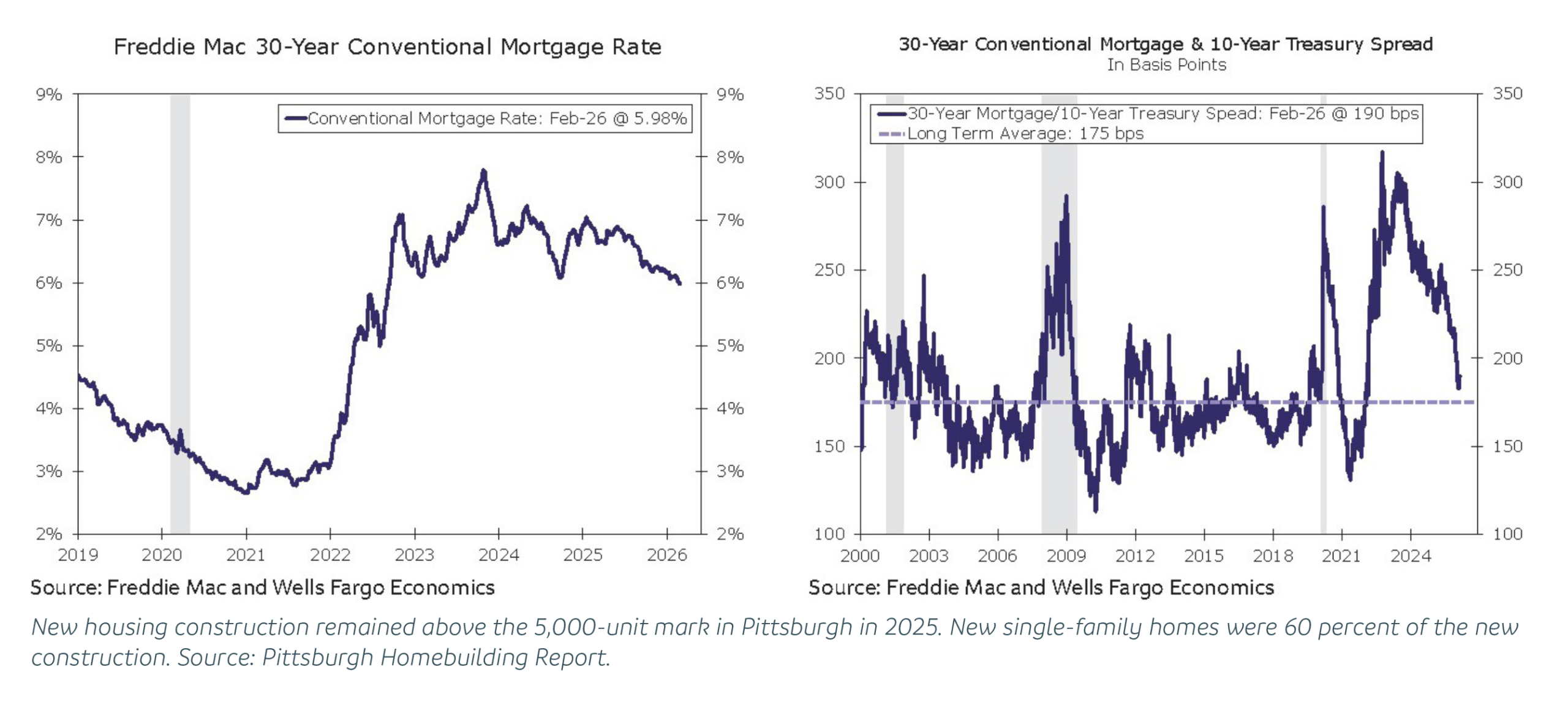
At current levels, the cost of borrowing money to purchase a home remains a barrier to home ownership, even though the interest rate for both 30-year and 15-year mortgage loans has been more than a full point below the 50-year average since the start of 2025. Since the end of the sub-four percent mortgage market in 2022, higher rates have been a drag on the housing market in two primary ways. Higher rates significantly increased the cost of home ownership and locked the owners of homes with lower rates in place.
Because of global economic conditions during and following the Great Recession in 2009, long-term bond rates remained near zero in the U.S. for more than a decade. When the Federal Reserve Bank began increasing short-term rates in March 2022, the interest on long-term bonds, and mortgages, jumped roughly three percentage points in the 15 months that followed. For borrowers, that meant a dramatic increase in monthly payments. For example, using the average 30-year loan principal amount of $258,000, the monthly mortgage payment jumped more than $562 from 2022 to 2023. That is the equivalent of adding $100,000 to the purchase price of a home. As might be imagined, such a stark increase in cost eliminated many buyers from the market.
For those homeowners lucky enough to purchase during the low-rate environment, the impact was different but equally chilling to the housing market. That same effective increase in cost due to higher mortgage rates made move-up buying that much more expensive. Owners of a $450,000 home that had accrued $200,000 in equity would also see an extra $100,000 in borrowing costs when they sold and purchased a new home. That difficult math has kept the majority of homeowners with mortgages under four percent from moving for the past four years.
“The issue is still interest rates,” says Tom Hosack, president/CEO of Berkshire Hathaway HomeServices, The Preferred Realty. “People who have a $250,000 mortgage at two and a half or three percent, for them to move up their payment will double.”
Much like in 2025, the mortgage industry does not expect to see much change in interest rates in 2026. The Mortgage Bankers Association (MBA) forecasts the fixed interest rate on a 30-year mortgage will remain at – not below – six percent throughout the year. That forecast assumes that rates will not be static, of course, but buyers will probably see variations in rate of one quarter percentage point, rather than volatile swings.
As the spring buying season kicked off, the average fixed 30-year mortgage rate was around 6.1 percent. The rate for a 15-year mortgage was 5.4 percent.
If long-term bond rates remain range-bound above four percent, the best prospect for lower residential mortgage rates is a reduction in the spread, or the amount that lenders charge on top of the base rate (such as the 10-year Treasury yield.). There have been some federal policy changes that are succeeding at keeping the upper range of mortgage rates near the current levels.
Fannie Mae and Freddie Mac, the two government-sponsored enterprises that purchase 70 percent of residential mortgages from private lenders, increased the size of their retained mortgage portfolios in the latter half of 2025, which pushed the spreads charged by lenders lower. In similar fashion, the Trump administration directed Fannie and Freddie to increase their mortgage purchases by an additional $200 billion in 2026. Coupled with increased competition among banks and private lenders, these actions have pushed the spread charged to borrowers above the base rate to less than two percent for the first time since 2022. Lenders do not expect that to change this year.
“It’s our anticipation that spreads are going to hover around two percent. Spreads change all the time, but our consensus is that there’s no justification we can see for them to go down and there’s no justification for them to go up in any dramatic fashion,” predicts Mike Henry, senior vice president at Dollar Bank.
Henry suggests that the extended period of stability will facilitate more sales, and he has early evidence to support that conclusion.
“Stable rates are good for the market because people can make better decisions,” he says. “The market is definitely competitive, but our pipeline of loans is up 120 percent compared to the same date last year.”
Any forecast for stability for 2026 must contain a caveat for the uncertainty that might result from the unexpected war in Iran. Few economists or political observers expect the U.S. to become embroiled in a lengthy conflict in Iran; however, a look at the impact of the first few weeks serves as a guide to how the war would impact the housing market.
Bond markets jumped one quarter of a point within the first week of the war, pushing the 30-year mortgage back up from its multi-year lows. Rates were higher in anticipation of higher inflation because of the spike in oil and gas prices that resulted from the immediate depletion of roughly 20 percent of the global supply of energy. A quick end to the war will keep inflation and rate increases short lived. Should the war-related disruptions drag on for even several months, however, the higher cost of buying and building will dampen the market for the foreseeable future.
The Outlook for Home Sales
January and February were not friendly for the housing market in Pittsburgh. An extended blast of Arctic cold kept buyers at home and tamped down sales. While real estate professionals would have preferred friendlier shopping conditions, the cold weather did not dampen optimism about a better market for home sales in 2026.
The law of supply and demand has been tough on first-time and move-up buyers since the pandemic and the economic disruption that followed widespread vaccination. Even as most aspects of the U.S. economy surged after vaccines rolled out in spring 2021, the number of homes for sale remained suppressed throughout the year. Virtually every home received multiple offers. Bidding wars were commonplace. The imbalance in the supply and demand drove double-digit appreciation that lasted until 2025. With each passing month, it seemed, buying a new or larger home became less affordable.
In March 2022, as inflation was nearing its nine percent peak, the Federal Reserve Bank began aggressively raising rates, pushing the short-term rates higher by five percentage points within 18 months. Not surprisingly, long-term rates followed suit, moving to as much as four percentage points higher. On top of double-digit annual home price appreciation, the higher cost of borrowing money was a double whammy for existing home sales.
By mid-2023, the price of the average U.S. home was nearly $40,000 more than two years earlier and the monthly mortgage payment had increased by more than $600.
Home ownership was pushed out of reach for a significant chunk of first-time buyers, many of whom had incomes that could have supported a home purchase in 2021; however, the reduced affordability did not dampen demand enough to match the supply of homes for sale. Moreover, the persistently higher interest rate environment created a “rate lock” for owners of existing homes with mortgages taken when rates were below four percent. Many homeowners whose life events – marriage, birth of children or career changes – dictated a larger home, found the cost of moving up was prohibitive.
As the past few years have unfolded, more homeowners have relented to the realities of the new “normal” for mortgage rates, choosing to sell and move, but the effect has been a trickle instead of a deluge. Each of the past five years has seen a slight increase in homes for sale, with a more significant increase in 2025 compared to 2024. In fact, since November 2025, the number of homes listed for sale in Pittsburgh – both existing and new – is 40 percent or higher than it was in the same month five years ago.
“Inventory has picked up some but is still at historical lows,” Hosack says. “At some point this has to break. Most real estate decisions are made around life events. You get married. You get divorced. You have kids or your kids move out. Those things have still been happening over the last four years. People just haven’t been selling their house.”
Realtors hope that is the beginning of a new long-term trend that puts more than enough homes on the market to satisfy the demand from buyers. Without an uptick in inventory, the Pittsburgh market will need a robust increase in new construction to provide more opportunities to buy.
The Outlook for New Construction
Too many buyers. Too few homes for sale. That is the recipe for a new construction boom, or at least it has been for multiple generations since World War II. But, even as the inventory of existing homes for sale plunged in Pittsburgh after the pandemic, new construction remained mired at anemic levels. A number of factors have been headwinds to a surge in new residential development that would be a relief valve for the housing market.
While there are some construction hurdles inherent to Pittsburgh, most notably the difficult topography and stifling regulatory environment, local builders and those across the U.S. have been stifled by higher costs, tight labor supply, limited lot availability, and interest rates that are still viewed as too high.
As 2026 began, some of these headwinds eased. Material costs seem to have leveled or eased in most markets, as tariffs were absorbed and increased competition put downward pressure on prices. The pullback in starts accelerated the steady increase in new lot development that was underway, leaving some major cities with more supply than has been seen since the Great Recession. According to Zonda’s New Home Lot Supply Index, new developments in Dallas and Atlanta now slightly outstrip demand and in Austin and Denver, the lot supply is more than 125 percent of the demand. Zonda places the overall lot supply index at 81.6, just slightly below the levels deemed “appropriately supplied.”
This modest improvement in the imbalance between supply and demand nationwide has not reached Pittsburgh, however, as construction increased while development challenges have not eased. There was no sign of a breakthrough in residential development as 2026 began, but there are more lots and land under development. Builders are poised to take advantage of the increased opportunities.
“Our lot inventory is higher now than it was a year ago,” reports Shawn Faulk, land development manager for D.R. Horton in Pittsburgh. “It does feel like there’s more development, but I don’t know if that’s because we went from one person doing acquisition to four or five. We are certainly having a good start to our fiscal year with land acquisition under contract and prospects.”
D.R. Horton’s entry to the Pittsburgh market has changed the development dynamics over the past three years. The challenges associated with residential development have not improved; however, the prospect of the nation’s largest builder aggressively looking for lots, in addition to Ryan Homes and Maronda Homes, mitigates some of the risk of development. The increase in market share for production-type builders, like Horton and Ryan, plus the continued growth of builders serving the empty-nester market, make it more difficult for custom builders to find opportunities for new communities.
“There are fewer lots available for the custom builders. Production builders have the money and can tie up the larger parcels,” says Darlene Hunter, vice president of new construction at Howard Hanna Real Estate Services. “I’m working with a builder from Atlanta on a project in Jackson Township that is on their family land, but they are going to be selling 78 of roughly 200 lots to D.R. Horton for single family homes, even though that’s a direct competitor.”
Builders that primarily serve the empty-nester market have also been successful at pursuing development opportunities. Pittsburgh’s demographics are supportive of more housing aimed at buyers looking to downsize or eliminate home maintenance from their lives. Four of the top 10 builders in the region target the 55-and-older buyers, and they report no drop-off in activity this year.
“We are on fire right now and I was not anticipating that in December and January. It’s not just traffic; it’s good traffic,” says Jason Corna, vice president, Residential Division of Kacin Companies in Murrysville. “I expect this will be a good year. The buyers seem to realize the landscape isn’t going to change very much. They’re not sitting on the sidelines anymore.”
“We’ve had tremendous traffic since the weather warmed. I was really pleased with that, but I don’t know if that’s a trend. I’m anxious to see what will come,” says Paul Scarmazzi, CEO of Scarmazzi Homes.
Scarmazzi reports that sales were down significantly in January, likely due to cold weather. He points out that there are still challenges to overcome in the marketplace.
“We will have good sales this year, but I don’t think we’re headed for much different than a flat year,” he predicts. “I’m feeling better now than a couple of months ago, but I don’t feel that we necessarily have the wind at our back. There’s still a lot of uncertainty.”
For the custom builders, the realities of the Pittsburgh market have meant building fewer, but larger, homes and working harder to find lots. Custom builders that develop land have had to pursue projects that yield fewer lots. Many have turned to working more with clients who own an individual lot, or to purchasing odd lots in developments that remain unfinished. Jeff Costa, president of Costa Custom Homebuilders, reports that his firm was able to purchase 11 lots in the high-end Fair Acres community in Upper St. Clair. After a slow start, sales in that community have picked up in recent months, he says.
“The market is still slow, but if a piece of property or a lot is good, it goes right away,” Costa says.
Most of the opportunities for any new residential developments will be smaller than what was typical a generation ago. While there is one project that will result in roughly 500 new homes, NVR’s Glade Run community in Zelienople, the majority of new communities will have fewer than 100 lots. In recent years, new land development opportunities of fewer than 20 lots have been snatched up quickly. Absent large available land tracts, developers and builders are taking advantage of what opportunities existed.
“Overall, there are more lots, but most haven’t come to fruition yet. Once the weather breaks and we get into June, we’ll see more developments ready to start,” says Matt Rost, regional market manager for Ryan Homes.
Ryan Homes, Pittsburgh’s busiest homebuilder, has responded to the presence of the nation’s busiest homebuilder by building in communities and school districts that it has not over the past two decades. Rost attributes the broader market dispersion to the scarcity of available land on which to build.
“I’d say there are more lots in school districts like Trinity and others in Washington County, or Jackson Township and Lancaster Township in Butler County, and not as many in the traditional areas because there’s less ground available,” Rost notes.
Hunter suggests that buyers looking for more opportunities, especially if they seek new construction, will do better if they are prepared to consider communities beyond the four or five school districts that have been most attractive in recent years.
“I get tons of emails every week from agents asking where to take clients for new construction,” Hunter reports. “The answer depends on what their needs are. Are they open to alternative areas? Are schools most important? What type of product? Is it single family or attached? There are limited opportunities and buyers must be prepared to look at areas that aren’t their first choice because of the limited availability.” NH